3/6/26
Cuteness in Contemporary Art: Nostalgic Escape or Radical Reclamation?
By Kitty Ess
This essay was written in 2025 for my fine art degree, hence why it has real citations! Despite being a pretty brief exploration of the topic (I was limited to 3,000 words), I'm still proud of it. Hopefully it's illuminating for readers of my site.
In the face of an uncertain world full of conflict and hardship, indulging in cuteness seems like the ideal way to escape, a way to "heal your inner child". Image sharing app Pinterest (2025) writes in their yearly trend prediction that in 2025 "people will be inspired to look at life from their very own doll's house. Pinterest users will take a playful approach to doll-style make-up, cutecore room ideas and necklace charms in the most whimsical colours.". When described in this way, it is easy to be cynical about the rise of cute aesthetics. Is enjoying cuteness simply a nostalgic regression, or perhaps an immature way of disengaging from the harsh realities of the outside world? Notably, Pinterest's (2024) main audience is women. Many have argued that reclaiming cuteness and femininity in adulthood can be radical (Lee, 2024). However, if many women have been expected to conform to these rigid gender norms early in childhood, can returning to them really constitute rebellion?
Contemporary art is a way to explore this question and other facets of cuteness, removed from the world of fashion or interior design. The female figure can be removed entirely, helping to create distance from the narrative that cuteness is an appeal to the male gaze. However, reactions to this experimentation have not been without scepticism. In 1994, the theorist John Morreall explained that the appeal of cute aesthetics lies in its proximity to the look of a baby. This has survival value for humans, hence why viewers feel drawn to a cute object. It is because of this automatic reaction to cuteness that causes Morreall to dismiss its use in art, since he argues that it creates sentimentality instead of inspiring critical thought. He writes that "the human race is lucky to have its automatic reactions, but those reactions could never be the stuff of great art" (Morreall, 1994:47).
Despite or because of this criticism, many artists continue to utilise a cute aesthetic in their artwork. This can be seen in the artwork of the Dutch artist Lily van der Stokker, which consists of large murals with pastel colors featuring flowers and round abstract forms. Sometimes they include domestic furniture like sofas and armchairs, seen in works like Dreaming Makes the World Go Forward (2010). The murals are decorated with mundane phrases based on van der Stokker's own life, in her own handwriting. In an interview with the film director John Waters she was asked if there was irony in her work, to which van der Stokker (2010:138) replies: "No. I love the decorative- the flowers, the curls and the nothingness. I love it because I am a girl, but then I'm also an artist.". Waters notes that her shows have been the subject of bad reviews and angry reactions from critics. This perhaps suggests that there's more to cuteness than the simple automatic nurturing reaction that Morreall describes. A cute artwork eliciting fondness in one viewer but vitriol in another suggests that cuteness may have more dimensions. Theorist Sianne Ngai writes in Our Aesthetic Categories that while cuteness is the aestheticisation of powerlessness, a cute object or artwork can still exert power over the viewer precisely because of its assumed powerlessness. Often, critics will mock cuteness by adopting the language of the cute, inadvertently being overcome with cuteness. Or, they may feel expected to offer the cute object something. Hence the feeling of manipulation, which can cause anger (Ngai, 2015:87).
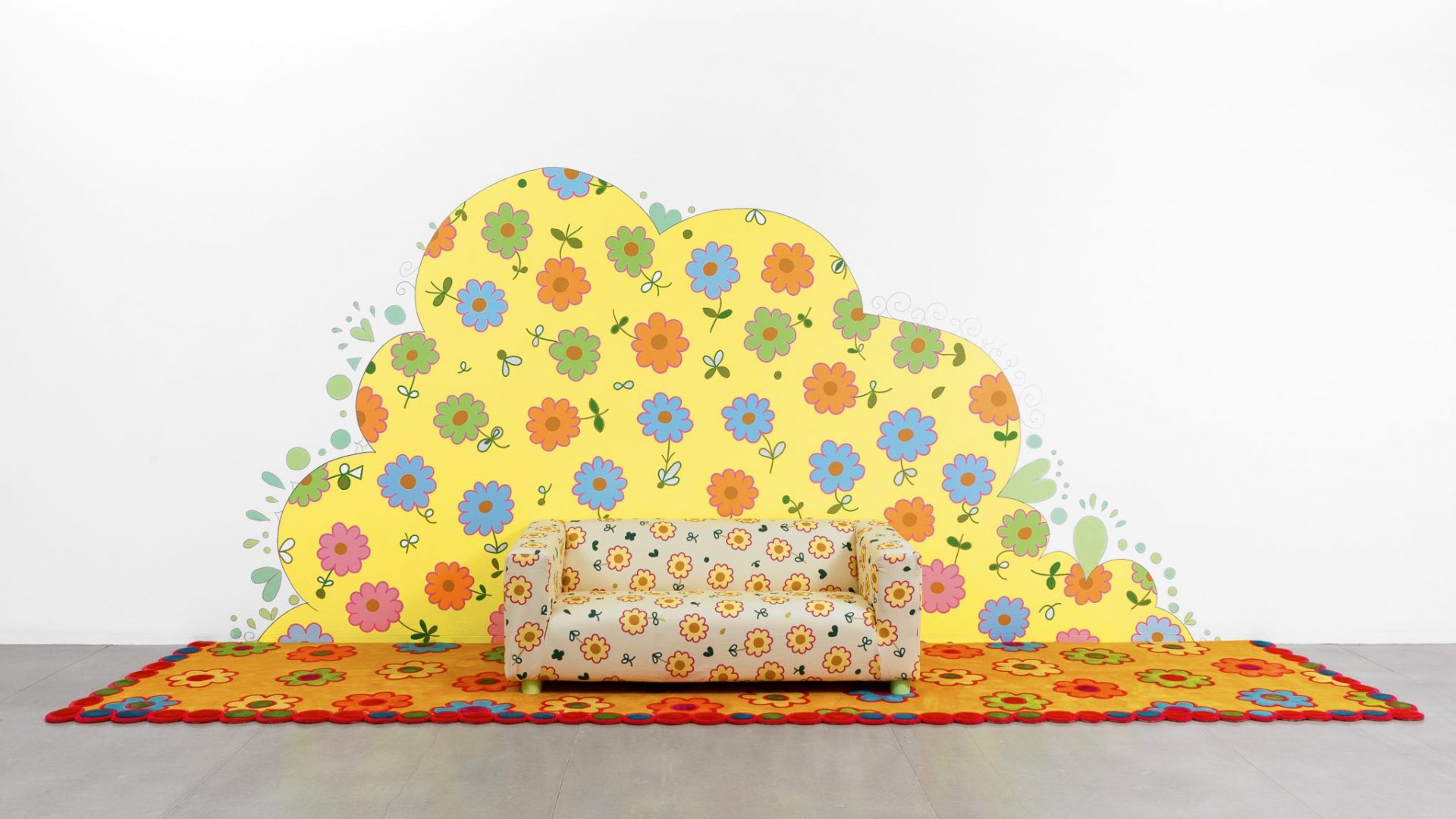
Fig 1. Dreaming Makes the World Go Forward (2010)
Another reason for the negative reactions could be that van der Stokker's artwork challenges those that have dismissed cute subjects as frivolous or kitsch, in the same way that Waters' movies aimed to challenge good taste. Theorist Robert C. Solomon writes that the label of kitsch has often been utilised by members of the upper class as "an attack on unsophisticated taste" (1991:3), targeting those of a lower socio-economic class. While kitsch is not exactly the same as cuteness, both are used as adjectives to reduce work to the gut feelings that it inspires. Plus, both imply that the subject is tacky, exaggerated or overly sentimental. Differing from Moreall, Solomon argues that to utilise kitsch in art is not shameful and is no more manipulative than utilising dark or upsetting subjects. Through this lens we can see why van der Stokker would choose to use a cute aesthetic. In addition, her use of domestic settings positions her work in conversation with the mundane and banal. Her work even starts out on the juvenile medium of paper and felt tip pen, then is transformed into a mural later. These works are displayed in gallery spaces, alongside more "serious" art. This could be viewed as a way to elevate these everyday experiences to something worthy of analysis. Her work is a celebration of the everyday, even when it is tacky, kitschy or "low class". John Moreall (1994:42) admits that "the traditions of western fine art have been male dominated and males have not valued the tender feelings involved in cuteness as an important aspect of art works". In fact, van Der Stokker was influenced by minimalism, pop art and conceptual art but aimed to "feminise" these art movements with her work (Clark, 2010:14).
Meanwhile, more recent art about cuteness often concerns the increasing prevalence of popular culture's influence over aesthetics, specifically in regards to the internet. Unlike art movements, the internet does not need to be feminised. As explained by feminist theorist Michele White in Producing Women, women online often "produce themselves as subjects" (2015:3) where they both shape and participate in the construction of femininity through online culture and communities. In this case, through sharing and modifying cute images. In the essay In Defence of Poor Image the theorist Hito Steyerl suggests that compressed, poorly sourced and bad quality images found online can be radical, despite being seen as undesirable. In the same way, cute, tacky and feminine images could also be radical, especially as these images are often transmitted over the internet, on apps like Pinterest. Steyerl (2009) writes that through online file sharing "Users become the editors, critics, translators, and (co-)authors of poor images." as opposed to just consumers.
Emily Mulenga's work is an example of using these cute and feminine "poor images" to construct femininity. Mulenga creates digital collages and videos using 3D models, in tandem with pop culture references. Her piece Flowerfield.jpg (2012) is a scene of an idyllic field of flowers, featuring an avatar for Mulenga created with primitive online chat game IMVU. Founded in 2004, IMVU gained popularity throughout the 2000s and 2010s, reaching three million monthly active users in 2011 (IMVU, 2011). In the game, users create avatars that they can dress up using items that have been created by other users. Like with Pinterest, the majority of users are women (IMVU, s.d.). While at first seeming like a digital utopia, where women are free to express themselves, the limits of the platform soon become clear. In virtual chat rooms, avatar movement is limited, with players only allowed to sit or stand in predetermined spots. The site also hosts advertising and brand integration, typically of real-world fashion and beauty products. Plus, despite almost infinite possibilities for customisation, most avatars adhere to white, eurocentric beauty standards. Even in the virtual world, women are still subject to the same pressures as in the real one.
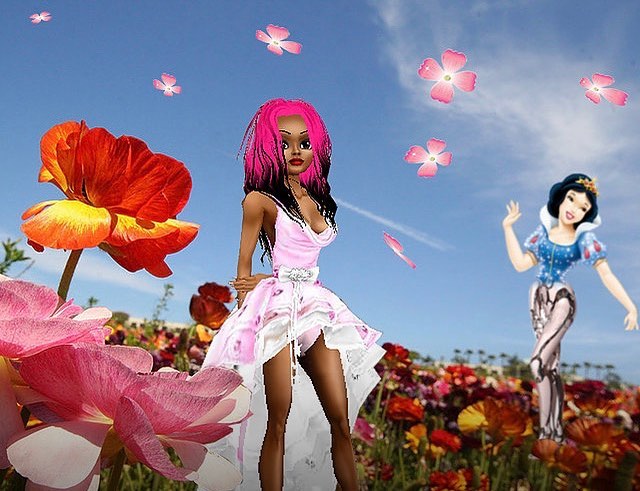
Fig 2. Flowerfield.jpg (2012)
The aesthetic of IMVU is imperfect, pixelated and somewhat uncanny. In Flowerfield.jpg, this becomes obvious, with the image of Mulenga's avatar placed next to a photograph of real flowers. Mulenga's avatar has long black and pink hair and wears a pink dress. These items were likely created by other users of IMVU, or Mulenga herself. By appropriating the aesthetic of IMVU in a digital collage, Mulenga celebrates the aspects of online culture that encourage creativity and freedom of expression for women. Simultaneously, her avatar breaks from the confines of the IMVU platform and stands next to a version of Disney's Snow White with robot legs, perhaps a reference to Donna Harraway's Cyborg Manifesto. While strange, the scene is undoubtedly cute and brings to mind childhood make-believe, with characters appropriated from different mediums coming together to form a new narrative.
Mulenga describes her work as "imagining worlds in which my digital avatar is presented with an escapist utopia where she, a mixed-race black woman, can thrive". This is further shown in her video piece 4 Survival 4 Pleasure (2017), which was also made using IMVU. Despite the low fidelity of the image, the music is triumphant as her avatar takes the form of a mermaid, a rockstar and a pianist. Through editing and animating her online avatar, Mulenga constructs a world of her own making and demonstrates that she contains multitudes. This work could be considered in conversation with Legacy Russel’s Glitch Feminism, where Russel proposes that the internet offers freedom for black, queer and femme people through performance and experiments with online identity. When describing the artist Juliana Huxtable's work, curator Adrienne Edwards notes that "the degree of [black women's] femininity has always been questioned". (2015:3) Through her art, Mulenga uses a hyper feminine aesthetic and is free to both reject and utilise femininity for her own ends.
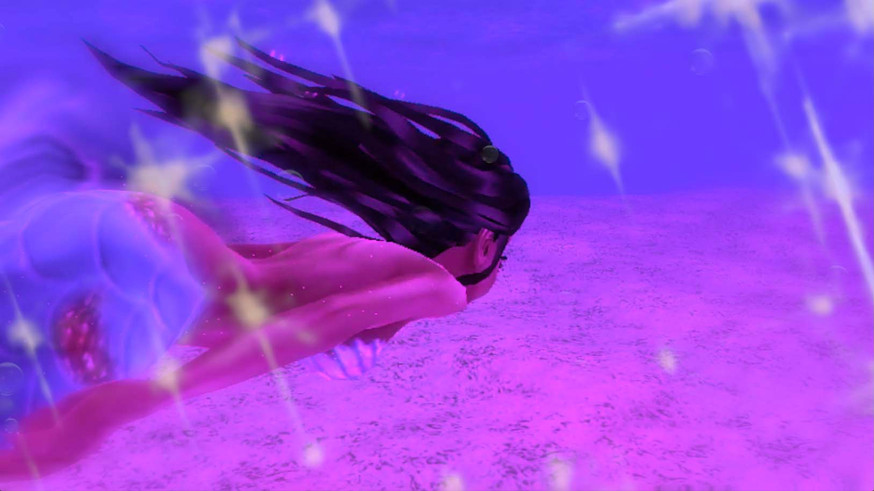
Fig 3. Still from Survival 4 Pleasure (2017)
However, at the beginning of 4 Survival 4 Pleasure there is a loneliness, with her avatar performing a piano concerto alone. Here, Mulenga captures the nostalgic feel of exploring an empty game environment. Mulenga states that her work is inspired by a childhood love of video games, as well as her experience as a millennial. Notably, millennials came of age when the internet was becoming mainstream. Meanwhile, Russel recalls that her experiences online as an adolescent shaped her gender presentation and helped her understand the power of creating multiple online identities (2020:4). Here, nostalgia for early internet exploration can be viewed as a temporary escape but it also allows for the reinvention of identity. Mulenga does not ignore the challenges she faces in the real world and instead builds upon them to imagine an alternative future.
Similarly, artist Rachel Simone Weil reinvents video game nostalgia using a hyper feminine, cute aesthetic. Her work manifests in research into video games marketed towards girls, as well as modifying and creating her own games. This art is created according to her design manifesto, one of the rules being "make it cute", aiming to question who belongs in video game subcultures. Since, in her experience, games targeted towards young girls have been denigrated in the retro gaming community, a symptom of how culture at large views femininity. Weil states that "[as a child] I was enamored with the aesthetics of birthday parties and weddings [...] as symbols for what they represented: celebration, love, and friendship. [...] I think they're asking a question, which is: "Why do we denigrate and mock girly aesthetics when their visual motifs so often represent love, kindness, and joy?" (Simmons, 2015).
This is demonstrated in her early work Hello Kitty Land (2003), a ROM hack of the original Super Mario Bros. for the NES where Mario is replaced by Hello Kitty. Other graphics in the game have been changed to adhere to a "girlier" colour palette of pinks and purples. Weil states that she learned assembly language in order to make ROM hacks, driven by her desire to see her preferences reflected in video games. Here, instead of cuteness being a rigid signifier of mandatory childhood femininity, it is a subversive way for Weil to learn and exercise technical skills in a joyful way. While cuteness is understood to be an infantilised version of femininity, here we can also view it as a nostalgic version of femininity.
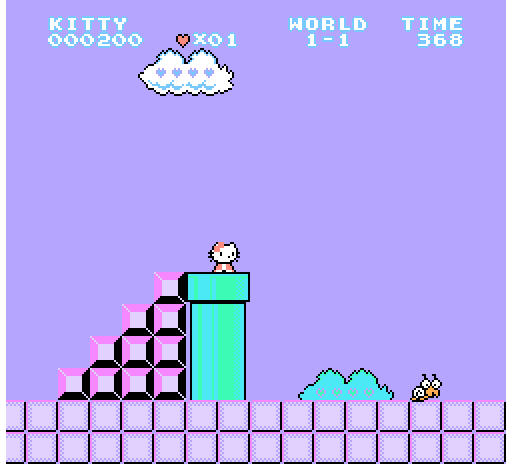
Fig 4. Still from Hello Kitty Land (2003)
Weil notes that her work is not advocating for a return to an idealised past and instead a way to imagine a way to move forward. She (Weil, 2020) is influenced by Svetlana Boym's book The Future of Nostalgia, where Boym proposes that despite its flaws, nostalgia is useful for imagining new futures. However, like kitsch and cuteness, nostalgia in art has been looked upon with scepticism. This dates back to the origins of nostalgia, which was coined in 1688 by Swiss doctor Johannes Hofer to describe the phenomenon of homesick soldiers (Arnold-Foster, 2023:19). It is derived from two Greek words, nostos and algia, which translate to "pain" and "returning home" respectively. In her book Nostalgia., historian Agnes Arnold-Foster notes that nostalgia was thought of throughout history as a sickness that affected only the weak. Specifically, throughout the nineteenth century, psychoanalysts thought of it as "backward-looking navel-gazing" and "[a return] to a time and place of intense misery and oppression" (Arnold-Foster, 2023:106).
Panics in the media around nostalgia have persisted since the nineteenth century, perhaps for similar reasons that cuteness has been maligned. For many critics, both words evoke a sense of bad taste and incurious sentimentality. In The Future of Nostalgia, Boym quotes historian Charles Maier, who states that "Nostalgia is to memory as kitsch is to art" (2002:14). It is only natural that contemporary artworks have also taken a more cynical view of both concepts. This can be seen in Mark Leckey's Dazzleddark (2023) which combines the kitsch and nostalgia of the British seaside town. It is a single-channel video piece depicting a plush unicorn and plastic pony toy that have been abandoned. Intercut with these scenes are images of neon lights and the relentless spinning of the fairground rides created with both 3D graphics with real footage. The soundtrack utilises dramatic organs, bells, and sudden, harsh synths. Instead of a blissful ode to British summer holidays, the film is an uncanny and harrowing viewing experience. Unlike Weil and Mulenga's work, it is hard to come away from it thinking positively about cute nostalgia. Leckey states that he chose a cute aesthetic because it "embodied something about contemporary popular culture" (2023).
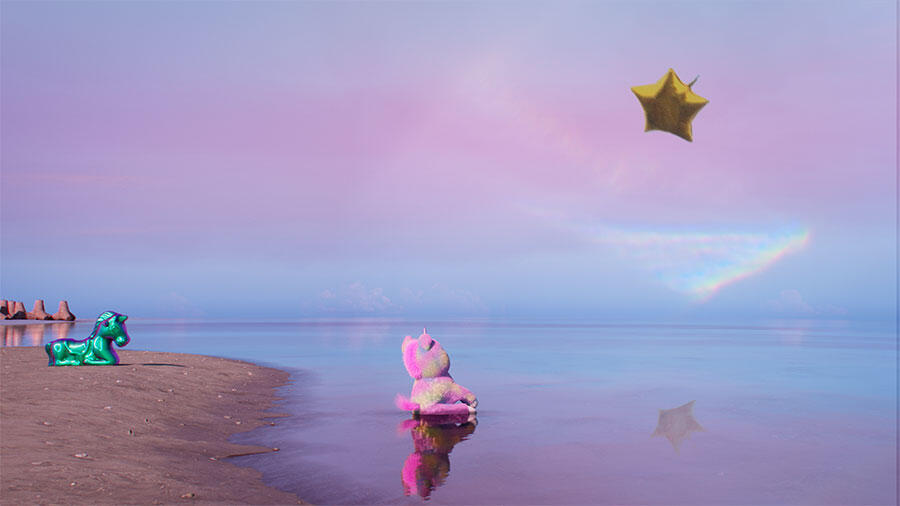
Fig 5. Still from Dazzledark (2023)
Here, we can see that the work addresses commodity fetishism. Ngai argues that cuteness as an aesthetic category is vital to understanding modern art's relationship to the commodity. She describes how in Capital, Marx "animates" commodities and imagines that they are able to talk, an extension of Marx's view that under capitalism they are considered almost magical. There is a sarcastic tone to his writing that demonstrates the ridiculousness of the scenario. However, through this comparison "It is difficult to critique the fetishism of commodities [...] without entering into its logic" (Ngai, 2012:62). With Dazzleddark, Leckey enters the logic of commodity fetishism, as the plush toys are not just inanimate objects. The magic of commodities that Marx describes is made literal, with the characters whispering and shouting to each other as they follow a magic star-shaped balloon.
Despite the sense of magic, the film ends with the toys abandoned on the shore, dirty and motionless. It is hard not to feel pessimistic about the waste created by funfairs, no matter how cute or nostalgic it is. While commodity fetishism is not necessarily concerned with overconsumption of material goods, it does obscure the labour that has allowed products to be created. Under capitalism, the market is thought of as a collection of relationships between objects, as opposed to controlled by real people. Here, through the Kuleshov effect, the film implies that the toys are simply magical products of the funfair, as opposed to of an underpaid factory worker. It is a child-like way to view commodities, but one that is encouraged by capitalism. Leckey also draws links between capitalism and the climate crisis, suggesting that looking out to sea with a brightly lit fairground on the shore is a reminder of melting ice caps and hotter summers (Hull, 2023).
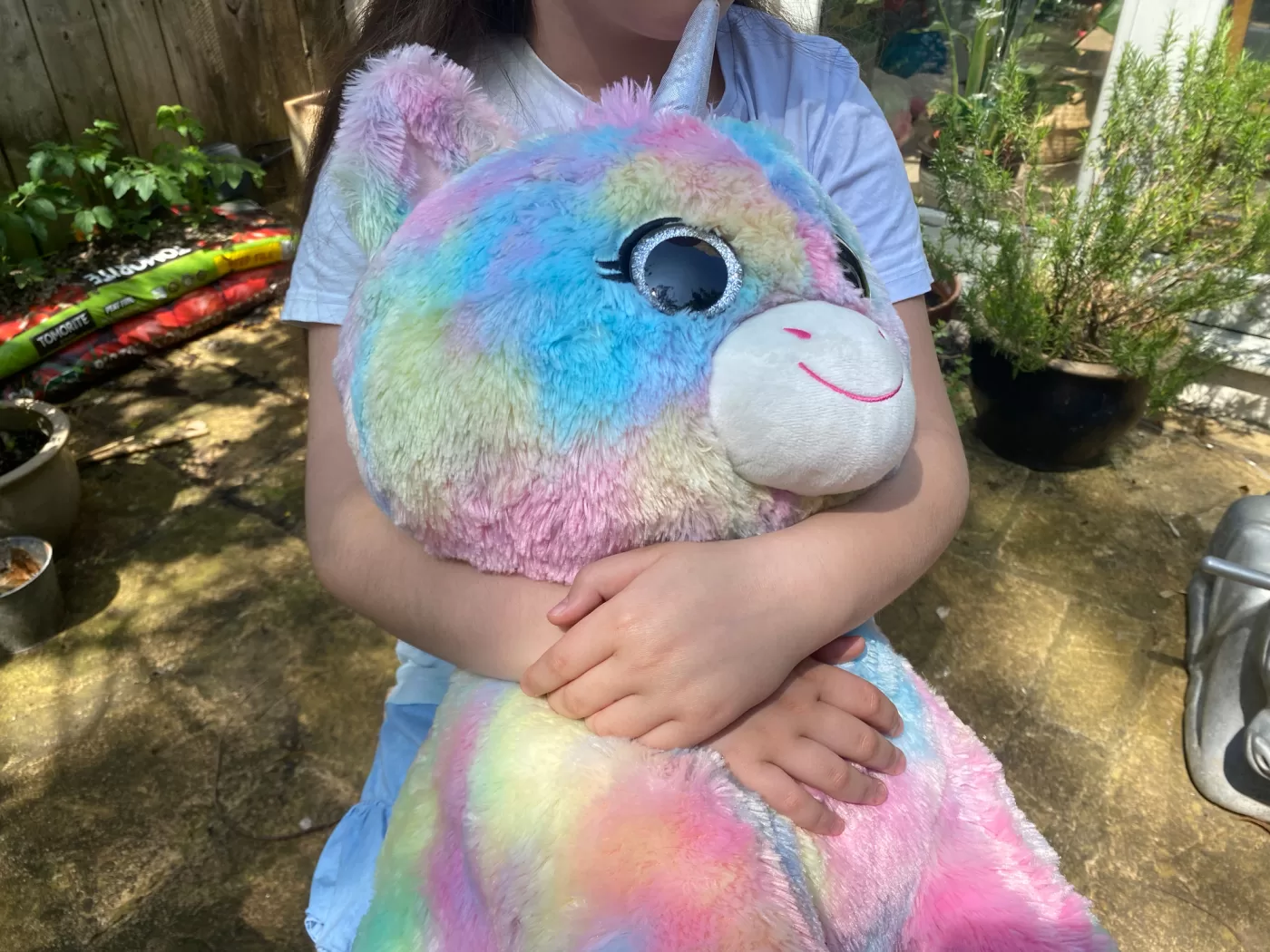
Despite being tonally dark, there is a strange beauty to the images that the work creates. The camera focuses on glitter flowing through the sea and the colourful light reflecting off helium balloons. Leckey notes with a fondness that the piece was inspired by watching children's television shows like My Little Pony with his young children. In addition, a photograph of his daughter holding the stuffed unicorn that stars in Dazzledark is one of his favourite pictures (Leckey, 2024). Considering this, it would be difficult to argue that Leckey is entirely opposed to cuteness. With this work he critically engages with cuteness in conversation with his two daughters (who he even thanks in the YouTube description of the piece). Despite cynicism, he has entered into the logic of cuteness and the "tender feelings" that John Morreall described as being foreign to men in the art world.
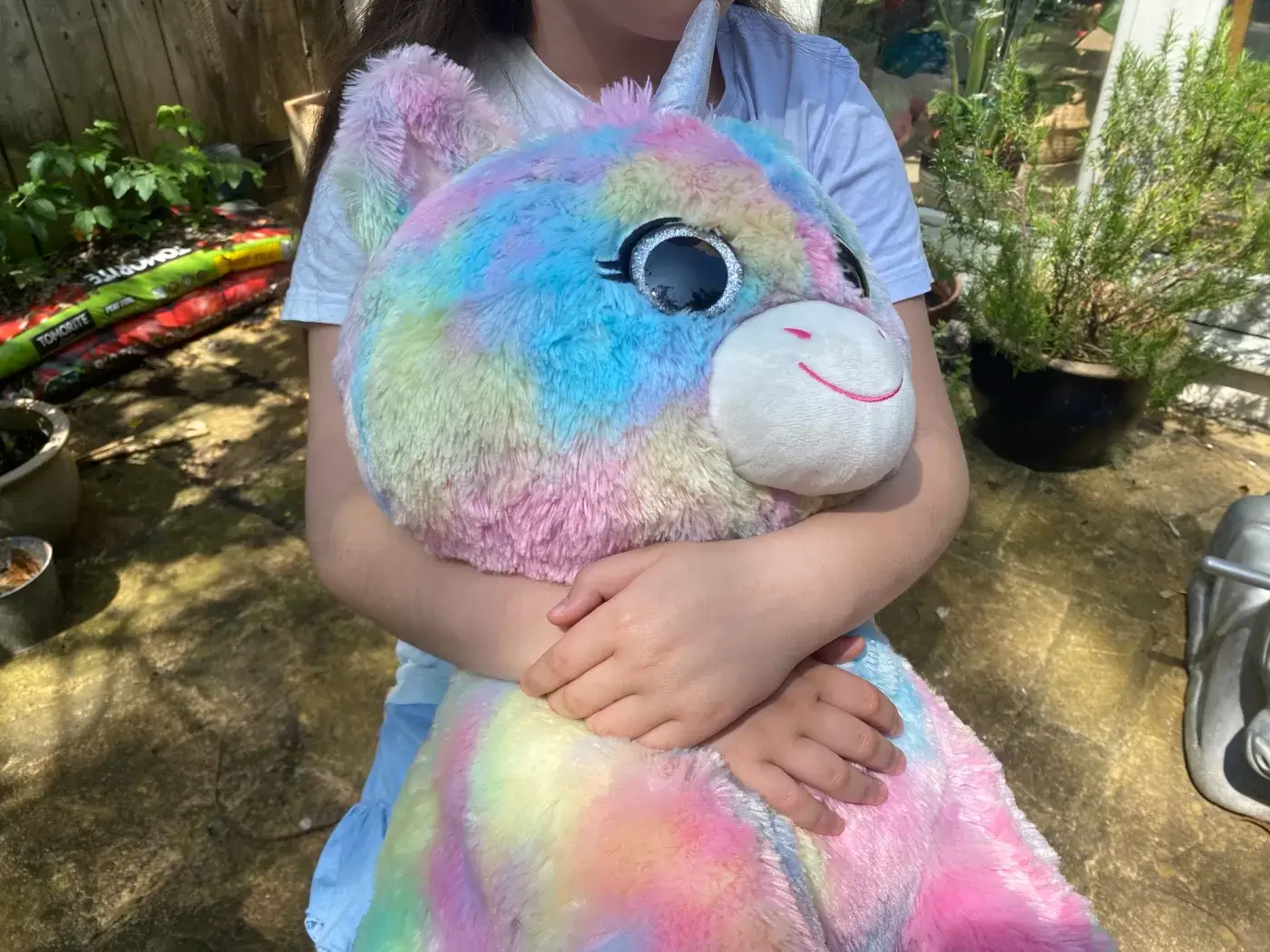
Fig 6. Leckey's daughter holding the plush unicorn from Dazzledark
It would be easy to dismiss this as contradictory. However, Ngai (2012:85) argues that cuteness is an inherently contradictory aesthetic category. It is no wonder that many artists find themselves both repelled and attracted to it. Each artist examined in this essay demonstrates a different perspective on cuteness, showing that it is a deeply personal subject that changes dramatically based on one's life experience. Ultimately, it seems absurd that cuteness could not be the stuff of great art as John Morreall once claimed. It seems he did not consider that cuteness could be approached from a critical or transformative framework. Whether it is an examination of girlhood aesthetics, a way for black female artists to construct an alternative narrative around femininity or a more sinister symbol of modern culture, cuteness in contemporary art is here to stay.
List of Illustrations
Fig. 1 van der Stokker, L. (2010) Dreaming Makes the World Go Forward. [Acrylic paint on wall and mixed media] At: https://kaufmannrepetto.com/site/web/app/uploads/2020/01/57.lily_van_der_stokker-kaufmann_repetto-tate_st._ives-no_big_deal_thing-2010-03-1920x1080.jpg
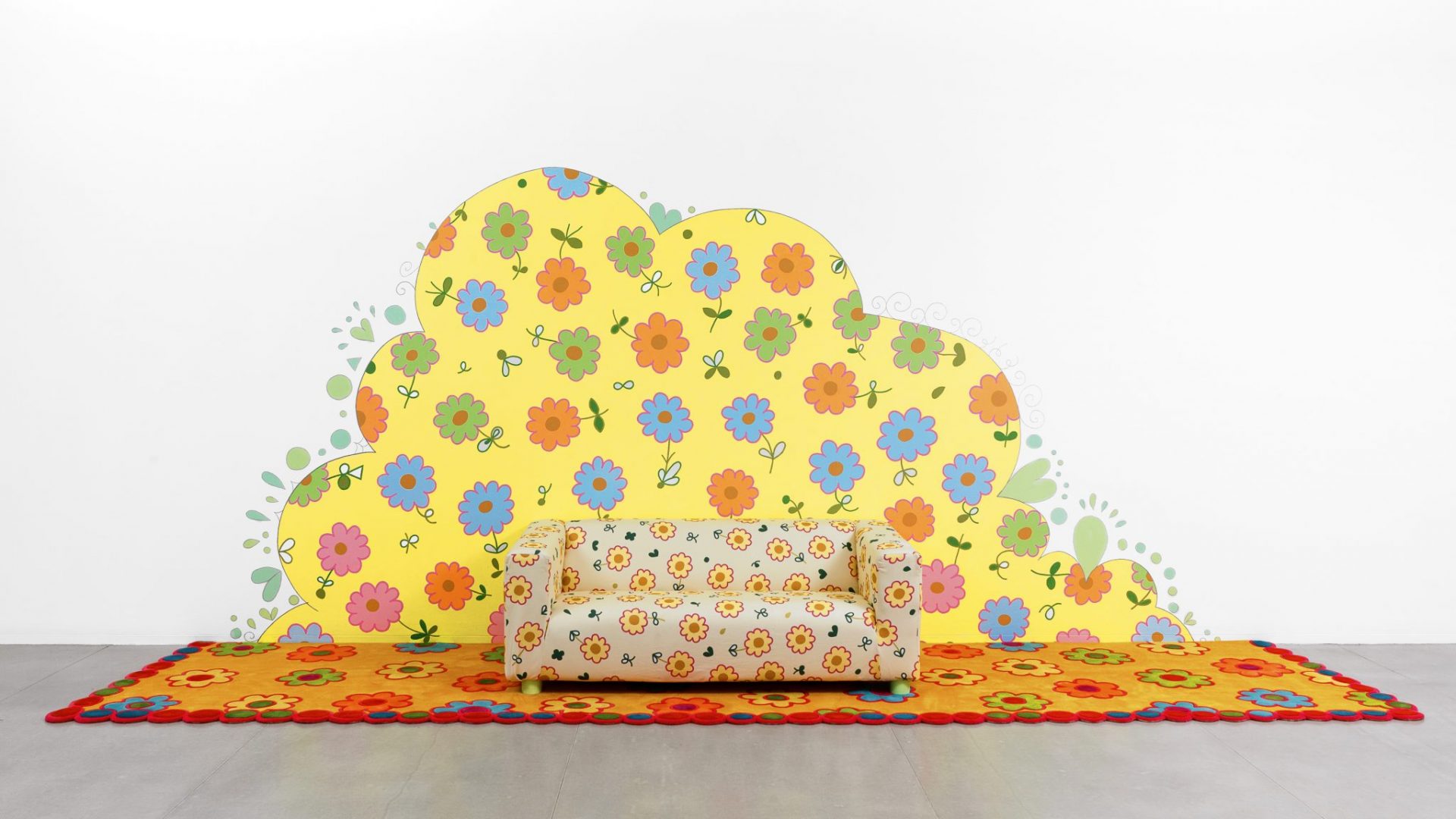
Fig. 2 Mulenga, E (2012) Flowerfield.jpg. [Digital collage] At: https://www.instagram.com/emilymulenga/p/Bg_CVlllYui/
Fig. 3 Mulenga, E (2017) Survival 4 Pleasure [Video Still] At: https://static.wixstatic.com/media/5d73c3_6b473d908f8d4282a0723b3a13723e41~mv2.jpg/v1/fit/w_1164,h_491,q_90/5d73c3_6b473d908f8d4282a0723b3a13723e41~mv2.jpg

Fig. 4 Weil, R. S. (2003) Hello Kitty Land [Game still] At: https://rachelsimoneweil.wordpress.com/wp-content/uploads/2013/03/kitty.gif

Fig. 5 Leckey, M (2023) Dazzleddark [Video Still] At: https://static.frieze.com/files/inline-images/mark-leckey-dazzleddark-2023-2.jpg

Fig. 6 Leckey, M (2024) Leckey's daughter holding the plush unicorn from Dazzledark [Photograph] At: https://plastermagazine.com/wp-content/uploads/2023/12/LAST_01-1400x1050.webp
Bibliography
Arnold-Forster, A. (2024). Nostalgia. Pan Macmillan.
Boym, S. (2001). The Future of Nostalgia. New York: Basic Books
Clark, M., Esche, C., Waters, J. and Tate Gallery St Ives (2010). Lily van der Stokker : it doesn't mean anything but it looks good. London: Tate Publishing.
De:Formal. (2021). Interview with Emily Mulenga - De:Formal. At: https://www.deformal.com/artists/emily-mulenga
Edwards, A. (2015). Relishing the Minor: Juliana Huxtable's Kewt Aesthetics. At: https://www.moma.org/d/pdfs/W1siZiIsIjIwMTYvMDEvMDUvOWF2bGY1dGlheF9NUDAxOTEyOF9KdWxpYW5hX0h1eHRhYmxlX0ZJTkFMLnBkZiJdXQ/MP019128_Juliana_Huxtable_FINAL.pdf?sha=c7926cb946ae0a60
Gordon, L. (2020). Disaster Aesthetics: How COVID-19 Made the World ‘Cute'. At:https://artreview.com/disaster-aesthetics-how-covid-19-made-the-world-cute/
Hull, A. (2023). How Mark Leckey's new group show explores British coastal towns. At: https://www.dazeddigital.com/art-photography/article/61060/1/mark-leckey-in-the-offing-turner-contemporary-margate
IMVU (s.d.). IMVU Media Kit. At: https://static1.squarespace.com/static/5a85dc3b18b27d11bc9b6f29/t/5f037acb16b6be249904302d/1594063566221/IMVU_MediaKit_v14.pdf
IMVU (2011). IMVU Information. At: https://web.archive.org/web/20110811101408/http://www.imvu.com/about/faq.php
Ireland, A. and Kronic, M.B. (2024). Cute Accelerationism. MIT Press.
Lee, N. (2024). Coquette: The ultra-girly movement sparking debate. At: https://www.bbc.com/culture/article/20240724-coquette-the-ultra-girly-movement-sparking-debate
Leckey, M. (2024). Mark Leckey's First and Last - Plaster Magazine. Plaster Magazine. At: https://plastermagazine.com/features/mark-leckey-first-and-last/
Manami Okazaki and Johnson, G. (2013). Kawaii! : Japan's culture of cute. Munich: Prestel.
Morreall, J. (1991). ‘Cuteness' In: The British Journal of Aesthetics 31(1), pp.39–47. At: https://academic.oup.com/bjaesthetics/article-abstract/31/1/39/94070
Ngai, S. (2015). Our aesthetic categories : zany, cute, interesting. Cambridge, Mass. ; London: Harvard University Press.
Ngai, S. et al.(2022) The cute. London: Whitechapel Gallery.
Pinterest (2024). How To Find Your Target Audience & Market | Pinterest Business. Pinterest. At: https://business.pinterest.com/en-gb/audience/
Pinterest. (2025). Pinterest's annual not-yet-trending report is here. At: https://business.pinterest.com/en-gb/pinterest-predicts/2025/dolled-up/
Russell, L. (2020). GLITCH FEMINISM: a Manifesto. London: Verso.
Simmons, K (2015). An Interview with Rachel Simone Weil. At: https://mirror80.com/2015/08/an-interview-with-rachel-simone-weil/
Solomon, R.C. (1991). ‘On Kitsch and Sentimentality' In: The Journal of Aesthetics and Art Criticism 49(1), p.1. At: https://www.jstor.org/stable/431644
Turner Contemporary (2023). Mark Leckey: Artist Spotlight - In The Offing | Turner Contemporary. At: https://www.youtube.com/watch?v=YcdSUbzNFS8
Vizcarrondo-Laboy, A. (2020). Seriously Cute: Six Artists Harnessing the Power Dichotomy of Cuteness. At: https://www.culturedmag.com/article/2020/11/17/cute-contemporary-art
Weil, R.S. (2020). NO REFUNDS | NO CASH VALUE | NO BAD MEMORIES. At: https://www.nobadmemories.com/inspirations
White, M. (2015). Producing Women. New York: Routledge.